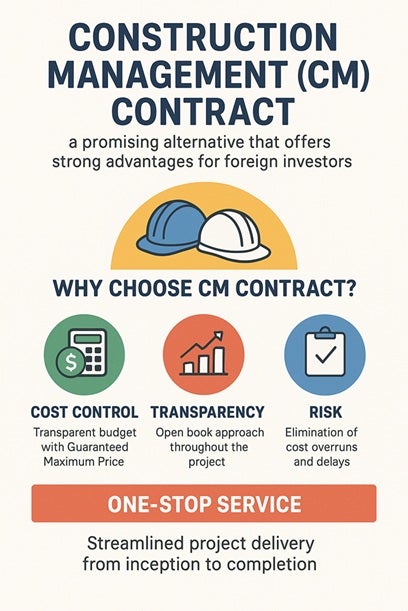
Different Contract Models for Foreign Investors: Choosing the Right Construction Approach in Malaysia
Introduction
Malaysia is a country rich in resources, infrastructure, and opportunities—making it one of the top choices for foreign investors. Whether building factories, warehouses, offices, or specialized facilities, investors must first consider a wide range of factors: land and location suitability, basic utilities, local authority regulations, engineering support, due diligence, feasibility studies, budgeting, value engineering, equipment, labor, and more.
Investors also need to understand that construction practices differ from country to country. For example, Malaysia’s regulatory processes, culture, and technical approach are not identical to those in other regions. Because of this, foreign investors often seek assistance from a Project Management Consultant (PMC) or a Design & Build (D&B) contractor. Increasingly, some global companies are exploring a third option—Construction Management (CM)—a flexible and transparent model that offers strong advantages for international projects.
As an experienced general contractor established in Malaysia since 1971, we understand both international requirements and Malaysian construction dynamics. To support investors more comprehensively, we offer a One-Stop Construction Management Service, including flexible contract types—particularly the CM contract, a promising alternative that simplifies project delivery.
Understanding the Contract Types: D&B vs. Pure PMC vs. CM
1. Design & Build (D&B) Contract
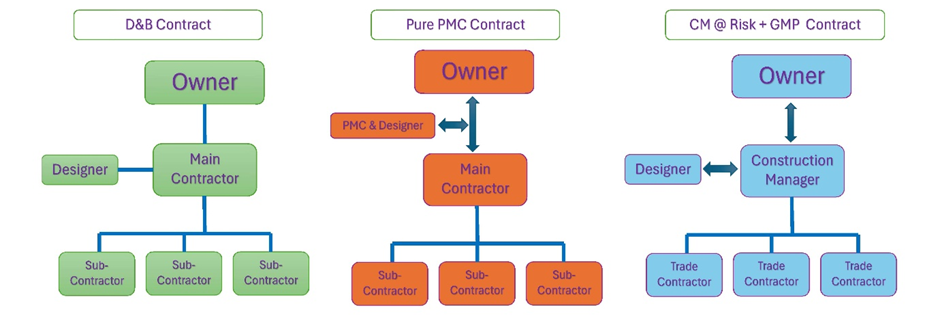
In a D&B contract, the client appoints the main contractor, who then manages:
- Development of detailed design
- Appointment of consultants (architects, planners, engineers, etc.)
- Local authority submissions and approvals
- Construction works through subcontractors
- Site management and project delivery
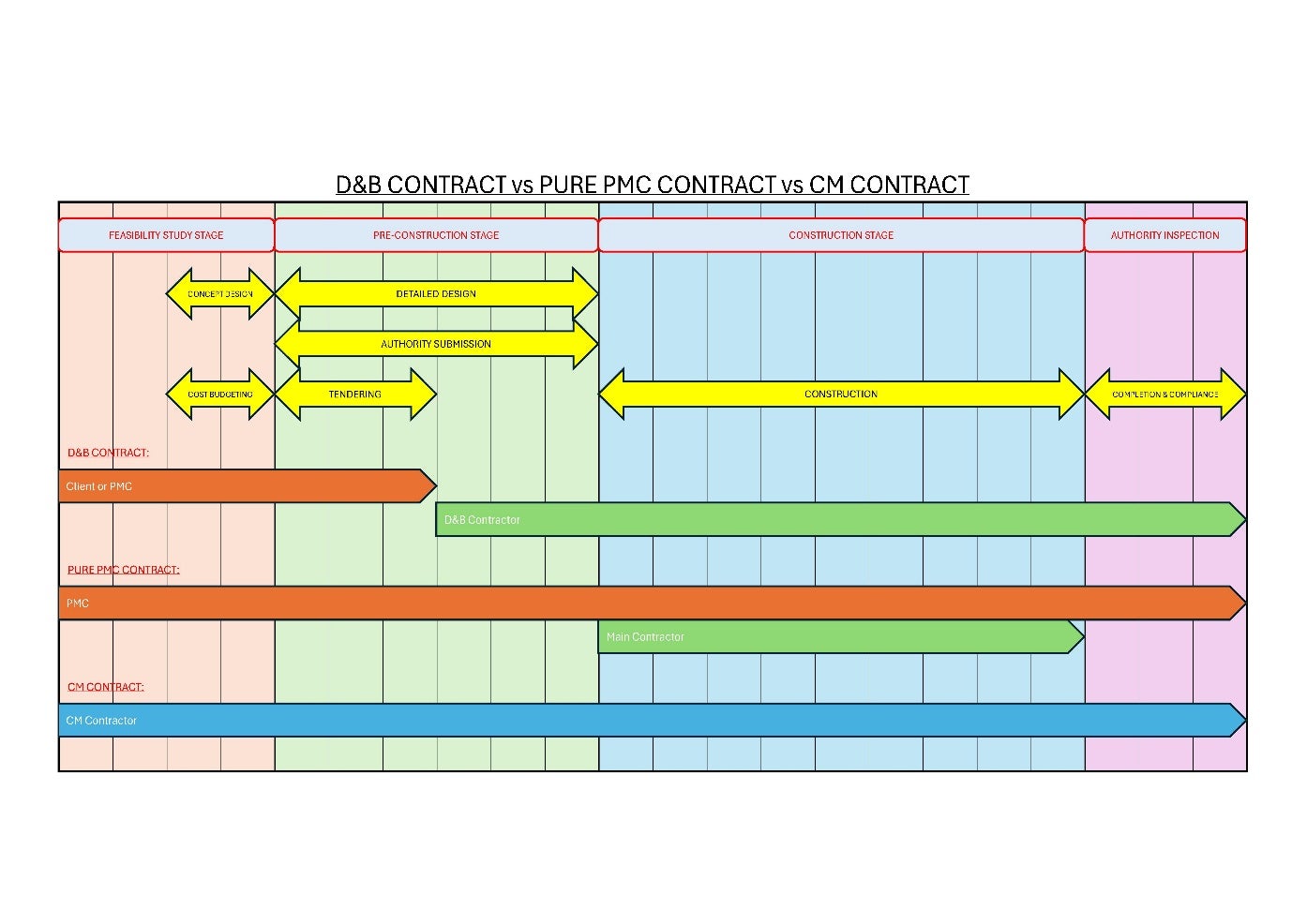
Some clients engage a PMC during early stages—such as concept design, Development Order (DO) submissions, or tender document preparation—before handing the project over to a D&B contractor.
2. Pure PMC Contract
In this model, the PMC manages the project from start to finish:
- Design development
- Authority submissions
- Monitoring quality, compliance, and construction progress
- Ensuring Certificate of Completion & Compliance (CCC) is obtained
Here, the main contractor is responsible only for construction works, while the PMC oversees the entire process independently.
3. Construction Management (CM) Contract
Under a CM contract, the CM contractor becomes involved from the earliest stage—even during feasibility study and budgeting—working side by side with the client. The CM provides:
- Early technical advice
- Budget estimations
- Feasibility and constructability analysis
- Transparent cost management
Cost is presented using a Cost-Plus model:
Estimated Base Cost + CM Fee
This approach eliminates the need for a conventional main contractor tender. Instead, packages are tendered directly to subcontractors, giving the client full transparency and cost control.
CM contracts are typically carried out in three stages:
Stage 1: Pre-Construction
During this stage, the CM contractor collaborates closely with the client to:
- Conduct feasibility studies
- Develop concept design
- Provide estimated budget cost
- Identify project specifications and requirements
Once the client confirms the budget, the CM contractor is officially appointed. Detailed design and authority submissions commence.
During this process, the estimated cost is refined and eventually fixed as a Guaranteed Maximum Price (GMP).
This means:
- The CM contractor ensures total cost does not exceed GMP
- Financial risk is removed for the client
- If the final cost is lower, the savings are shared (part to client, part to CM contractor)
This structure is called CM at Risk + GMP, giving clients peace of mind and cost certainty.
Stage 2: Construction Documentation
This stage runs from pre-construction until final completion and includes:
- Pre-qualification of subcontractors
- Tendering and evaluation for each trade package
- Awarding construction packages
- Financial management and cost reporting
Transparency is a key feature of CM:
- Clients see the actual cost of every trade
- Price comparisons are presented before awarding packages
- Project financial status is tracked closely and reported clearly
Packages are divided according to trade to streamline management and coordination.
Stage 3: Construction Management
During construction, the CM contractor provides:
- A full project management organization
- Technical support and engineering supervision
- Planning, scheduling, and coordination
- Quality assurance and control
- Cost and time management
The CM contractor ensures all inspections are passed and ultimately secures the Certificate of Completion & Compliance (CCC) or equivalent approvals.
Conclusion
For foreign investors entering Malaysia—the Construction Management (CM) contract offers a flexible, transparent, and efficient model that simplifies the entire development process. While CM contracts are not yet mainstream in Malaysia, they are a compelling and highly effective alternative for investors seeking transparency, cost control, and a streamlined project experience.
As a leading construction company established in Malaysia since 1971, holding the CIDB Malaysia G7 contractor license and certified with ISO 9001:2015, we are fully equipped to deliver reliable, compliant, and high-standard construction solutions tailored for global investors.